
Questions about Custom Wigs
Read about our wigs and how they can meet your needs in daily use here.
When you commission a wig or item of facial hair from us, you’ve got our full team at your back. While you should always email us if you have questions, our Wig Owner’s Manual is the best place to start learning all about wearing and caring for your wig or facial hair. You’ll also find tons of great tutorials and resources on our blog.
When your wig needs some TLC, you can send it back to us for our Cleaning and Maintenance Service. We want you to love your wig and feel completely comfortable with it – so don’t hesitate to email, call or set up a skype session with us!
Yes! We offer a number of installment plans. Visit Payment Plans for more information.
We take payment via credit/debit card, paypal, square and Chase Quick Pay/Zelle.
Every single hair is tied in, by hand. All 40,000 (give or take a few) of them, and yes, it does take a long time – but the result is worth it! Doing this allows for the utmost control over the shape, style, texture and color of a wig. It also creates a wig that is thin where it needs to be so that it looks very natural, and conforms to the head and hair of the client. A fully ventilated wig, which includes a lace front, also allows for the maximum amount of versatility in styling and re-styling.
Every piece is made by hand. The hairs are knotted into a tailored foundation of sturdy mesh, which is very lightweight and durable, allowing for a lighter, cooler wig or beard. At the hairline of both wig and beard, we use a light, transparent mesh (generally referred to as a “lace front”), which lays against the skin discreetly. All of this ensures the hairs looks as though you have grown them yourself, even up close.
Wearing lace front wigs
It’s important your own hair be arranged the same was it was for your head tracing. That ensures your wig will fit correctly. If the wig doesn’t fit correctly, then you won’t be able to apply it correctly. Position the wig on your head and gently pull it forward so the lace front covers your forehead and the wig’s hairline covers your own. It’s best to do this in front a mirror, especially the first few times you apply your wig.
Once the wig is in the correct spot, you need to secure it to your head and face. If you have hair ‘in a prep’ under the wig, you may want to start by pinning your wig to your head through your own hair. That will keep the wig on your head. If you don’t have enough hair to put into a prep, then you’ll simply proceed to the next step.
Once the wig is in place and pinned if necessary, use liquid adhesive or double stick tape to secure the wig lace to your skin at the temples. In almost all cases, that’s the only spot you will need to use glue or tape.
Wearing lace beards and other facial hair
If your custom beard has an elastic strap, then you can put it on and set it into position, letting the strap do the work of keeping the beard on. For pieces that do not have a strap, you’ll need to glue or tape them in place. Whether it’s a large beard, a small goatee or a mustache, start in the middle and work your way out. That will ensure the piece is in the right position.
If you’re using liquid adhesive, paint a thin coating of it onto your skin, then let it get tacky. Press the piece into the glue, beginning in the center and working your way out. Note that some adhesives may have other application methods – so always defer to the manufacturer’s instructions and recommendations.
If you’re using tape, peel one piece of the tape backing away to reveal a sticky surface. Then press the sticky tape onto the piece where you want to stick it to your skin. Put all the pieces of tape on the piece, then carefully remove the other backing. If the backing is difficult to remove, try creasing one corner of it.
Once the piece has all the tape you wish you to use attached and the backings are removed, press the piece to your skin, beginning in the center.
We have a video of both the head and chin tracing, which you can watch here – How to Take a Head Wrap and How to Take a Chin Wrap
Here’s the head tracing video
And here is the face tracing video
When you commission a custom wig or hair good, the first step is the head or chin tracing. This is a simple and quick process for getting the shape and size of a client’s head, along with a detailed tracing of their hairline. Taking a head tracing (or chin tracing) is very simple. Clients are able to complete the process on their own using our step-by-step video and mail the tracing to us or visit our studio in Louisville, KY to have a tracing made. We use the tracing to tailor a wig foundation which fits their head, and into which we knot hair. We have both written instructions and a step by step video of the tracing process.
A custom wig or beard is an investment. With good care and handling, you can expect one of our custom pieces to last for many years, even with heavy wear. If the day comes when your pieces aren’t looking as fresh, we can simply put a brand new lace front onto the wig or beard, extending it’s life by many more years. Read more about the care and handling
The creation time of a custom piece depends largely on the complexity of the piece and on the build schedule of our shop. Custom Wig Company generally books several months in advance, especially during the busy Halloween and Christmas seasons. In general, you can expect the build of your piece to take six to twelve weeks. When you commission your piece, we will be able to give you a timeline and a delivery date for your piece. While wee are able to accommodate occasional rush orders for an additional charge, it’s always best to order early if you have a deadline.
Depending on the time of year you order, it can take 6-12 weeks. We recommend ordering your custom project as early as possible to ensure timely delivery.
The cost for any custom item depends upon the nature of the piece, but a very general range is $1250-1800 for wigs and $200-$800 for beards. We offer flexible payment plans.
It is best to clean the lace immediately after wearing. Pour 90% isopropyl alcohol into a bowl and very briefly soak the lace edge in the alcohol to loosen the glue. Once the glue has loosened, remove the lace from the alcohol, lay it on a old towel, and use a soft towel to very gently rub the spirit gum off of the lace. If this doesn’t remove all of the glue, return the lace to the alcohol and repeat. It is better to soak and re-try than to try and scrub the lace to remove spirit gum, as the lace is delicate and can tear through rough scrubbing. The sooner you clean glue off of your facial hair after wearing, the easier it will be to clean. Easier cleaning means less wear and tear on your pieces!
For more information, check out this guide to cleaning and caring for any lace front piece
To remove spirit gum that may have gotten into the hair, a gentle paste of water and baking soda can be used to loosen up the glue, allowing it to be shampooed out with a mild shampoo. Frequent, careful cleaning after each wearing is the key to maintaining your pieces in the best possible condition.

A lace front wig prior to final gluing. It is sitting in front of the model’s own hairline slightly and is on the head straight.
The virtue of a lace front wig is that the transparent lace lays over the forehead and allows the hand-knotted hairline to sit on top of your own hair line. In general, your goal is to ease the wig onto your head, letting the lace front settle down onto the forehead. Then check that the wig is sitting on your head straight – it should be the same distance from your ears on either side and the temples or sideburns should be level with each other. Once it is sitting correctly on your head, make sure the lace front is all the way down on your forehead, and that the knotted hairline is at or just slightly below your own hair.
You can pin the wig to your head if you have hair under the wig or a wrap on your head to secure it to. Otherwise, you can simply apply tape or adhesive to the lace front, the temples are generally the best place to do this. Lift up the lace edge, brush on adhesive or apply tape, wait a moment for the glue to get tacky, and then press the lace firmly into the glue, using a foam sponge or piece of silk to keep your fingers from sticking to the glue or tape. You may discover that the fit or style of your wig does not require gluing or taping the lace down.
Yes – We can dye human hair nearly any color imaginable. The results are vibrant, accurate and colorfast! As with any wig, we use subtle highlights and lowlights in conjunction with the base color to provide the most dynamic color. We can do multi-colored wigs, two-tone wigs, or ombre wigs – the sky is the limit.
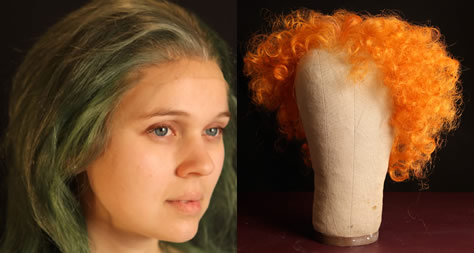
Custom wigs dyed in greens and orange. The hair is dyed prior to building the wigs in order to allow for the most natural blending of highlights and lowlights
Check out our “Wig Owner’s Manual” and learn what to expect!
It might – but we have a variety of techniques to prevent that. While lace fronts ARE very thin and delicate, they are far more opaque than they appear. In some instances, darker hair under a lighter hairline can actually enhance the appearance of the wig by adding a subtle shadow to the hairline. If there is a significant contrast between the client’s hair and the wig hair, we can put a lightweight silk layer (called a “blender”), dyed to match the client’s skin tone, under the foundation of the wig to help their darker hair disappear. For REALLY high-contrast situations, such as a black haired Santa, a blender might be used in combination with a light application of temporary “hair white” to help lighten up the client’s hair under the wig.
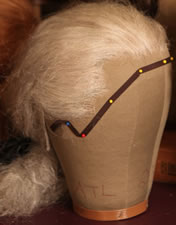
A lace front wig blocked down using twill tape. This is a “basic” blocking for storing and minimal styling. If you are going to put the hair in rollers or handle the hair vigorously, us more pins along the twill tape to further stabilize the wig.
With proper care, human hair is durable and versatile. However, since your wig is made up of many tiny knots, it is important to handle it carefully as the knots can work loose, causing the hair to fall out. Any time you are going to style your wig, you should place it carefully onto a wig block (available from wig retailers) and pin it down across the lace front, using a piece of twill tape between the pins and the lace to help protect and stabilize the lace (this is called “blocking”). Twill tape is a simple woven band that can be purchased at any sewing or craft store – narrow silk ribbon or bias tape can also be used to block a wig.
You can brush and comb your wig as needed, but it is best to use a wide toothed comb or wig brush as they are most gentle on the hair. If the hair has become excessively tangled, use a spray on conditioner or de-tangler, available at any super store or drug store. To learn more about washing any human hair wig, check out this guide
You can use heat tools to style human hair wigs, but be careful to use a low temperature and keep a close eye on the hair to ensure it doesn’t over heat. If you are going to use heat on your wig frequently, purchase a heat barrier/protector spray and apply it to the wig before using heat. Depending on the style, you may want to use rollers to style your wig – if you roll your wig, it is very important to make sure the wig is blocked down correctly as the tension of the hair in the roller can tear the lace and other foundation materials.
Human hair wigs work well with most commercial hair products – gels and mousse can be applied while the wig is damp, hair spray can be used to set a style – be wary of reapplying hair spray to a wig, as it can build up quickly and cause the wig to look dull and damaged.
If you don’t feel comfortable washing and re-styling your wig, we offer cleaning and maintenance service for our clients.
Yes! One of our specialties is making wigs based on famous heads of hair. Mark Twain wig? No problem! George Washing wig? We’ve got you covered! Marilyn Monroe wig? We can do it! Visit our Famous Figures to see some of the projects we’ve done!
All wigs need some TLC from time to time – we cover the basic tasks you should to do to keep your wig in tip top shape in our Wig Owner’s Manual . Routine maintenance includes the basic things you’ll need to do after each wearing, like removing glue or tape from the lace or checking the nape for tangles.
It’s very important to us that our clients be satisfied with their custom items, and we work very hard to ensure that. If you receive your custom wig or item of facial hair and find that there are issues with the fit or appearance or that it’s just not quite doing what you had in mind, we encourage you to let us know right away so we can figure out the best way to make the piece right for you. That might mean that we make some adjustments to the piece or it might be an issue we can help with by offering some advice on wearing or handling.
We send photos of the finished piece to you before shipping. That way, you can see how it looks, and request any changes or adjustments. Once you have item in hand, if something in the fit is incorrect, or if the style isn’t quite right, just let us know. We can correct or change the problem and return the piece to you quickly – some adjustments at this stage of the project aren’t uncommon with custom items.
We do not allow returns or refunds on custom items, but we do everything we can to make sure the pieces are exactly what you want and need.
A lace front refers to the foremost visible edge of the wig, that part that covers the forehead and hairline. Because the fine piece of wig lace (a transparent mesh) disappears when laid on skin, wig makers use it for the front edge of wigs – we tie tiny knots into the fine mesh to create a natural, realistic hairline and then let the lace drape out over the forehead so that the fine knots of hair appear to be growing out of the clients own scalp.

 On the left. a ventilated (hand knotted) wig with a lace front. On the right, a machine made “fashion” wig with a hard front. The small “flaps” visible on the temples of the lace front wig are glued down during normal wear to present a seamless front. A lace front is more natural in appearance and also allows for a more accurate and comfortable fit.
We offer a range of installment plans, you can read about them on our Payment Plans page.
Payments can be made with a credit/debit card via paypal or square. We also accept payment via Chase Quick Pay/Zelle.
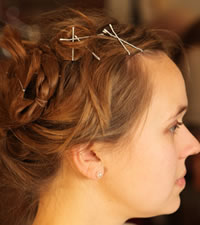
The model’s hair prep without the wig cap. Notice that the bangs are secured back with crossed bobby pins and that her pin curl (seen above the ear) is flat and tight and is well behind the hairline. On the back of the head, her long hair has been braided and pinned up on the head
A pin curl is nothing more than a simple way to secure and flatten a lock of hair to your head. The term originally referred to a method for coiling hair and securing with bobby pins in order to produce a wave pattern in the hair.
For our purposes, it merely means to take a small piece of hair, no more than one inch in thickness (less if your hair is very, very long or very thick), twist it lightly from root to tip, and then place in a coil on the head, securing with a pair of crossed bobby pins.
The goal is for the pin curl to be as secure and flat as possible – it is better to make the pincurl wide and flat than to make it small and squat, as a fatter pin curl will make your wig sit higher off your head, which will make the wig look less natural. If you routinely wear wigs, try to move the location of your pin curls around your head slightly so you are not putting stress on the same piece of hair day after day.
If you have hair longer than 3 or 4 inches, you can make two small, flat pin curls on the top of your head and put the remainder of your hair into either flat pin curls on the back of your head OR a couple of tight braids if your hair is long or thick. The goal is for your own hair to be as flat, tight and unobtrusive as possible under the wig. Once your own hair is secured, put a mesh wig cap (the closer in color to your own hair the better) over it, and pin the cap to your head with bobby pins. This will help keep your hair contained, and give you an extra layer to help anchor the wig to.
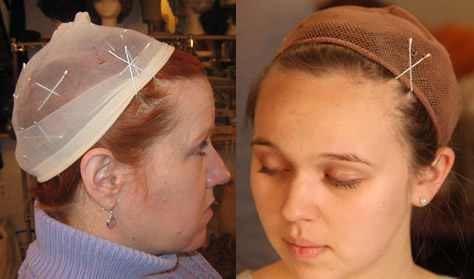
Two views of proper hair prep for wearing a wig. Notice that the hairline is exposed around the front and ears and that the cap is secured with crossed bobby pins. It is important to secure all hair in the wig cap and to place the wig cap well behind the hairline in order for the lace front to cover the natural hairline most effectivly and naturally.
If you have hair shorter than 3 inches, or little to no hair, you can use self-sticking athletic wrap to provide an anchor point for your wig. This wrap is available at most pharmacies and sports store. Cut a piece from the roll that is about two times your head measurement. Wrap it tightly around your head above your ears, leaving your hairline exposed. The wrap will stick to itself – make sure it is very tight around your head, and then use pairs of crossed bobby pins to secure it. The closer in color your wrap is to your hair color, the better.
In order to help your wig stay on your head, you should secure it with bobby pins and hairpins. If you have pincurls on the top of your head, use large hairpins to secure the wig into each of the pincurls. These will be your primary anchoring points. Then use pairs of crossed bobby pins to secure the back corners of the wig – you are trying to sandwich the back edge of the wig and your wig cap or sport wrap into the bobby pins.
You can also use pairs of bobby pins to secure the areas above your ears, or anywhere else you feel the wig would benefit from being secured.
Follow up the pinning process by using adhesive or tape to attach your wig lace as needed.
A custom wig or piece of facial hair is built to fit YOU, using high quality hair in the colors and texture you choose, and when it is complete, it will be styled to your liking. Commercially available wigs have many uses, but if you are looking for the most comfortable, believable and highest quality wig, you need a custom piece. It’s an investment in your work, life, hobby or art that will last for years! For more information on the most common types of wigs and how to choose the right one for you, please check out our post What About Wigs? and What About Wigs Part 2
Regretfully, we do not buy hair from individuals and we are not able to use donated hair to make a wig. We work with a handful of reputable, reliable suppliers to get all of our human and synthetic hair.
Historical FAQ
The cost for any custom item depends upon the nature of the piece, but a very general range is $1250-1800 for wigs and $200-$800 for beards. We offer flexible payment plans.
Santa FAQ
We’re always happy to see our clients in person, but it’s not necessary to having a successful custom set created. By mailing in the head and face tracings, we can build your set to fit you without the need for travel. If you do opt to travel in for a fitting, you can still simply mail in the tracings and then schedule a fitting and pick up date when the set is completed.
You can keep your set in tip top shape by using our Santa Care Cleaning and Maintenance Service annually – this service provides proper cleaning of wigs, beards and facial hair and checks each piece for any wear and tear issues, and addresses any repairs or changes that might be needed.
Yes – starting in 2016, all of our custom and ready-to-wear wig and beard sets will come with an elastic strap. Because we only advise using the strap if you have a wig or very full hair, Santas purchasing just a beard should let us know if they prefer a strap on their beard.
Every piece is made by hand. The hairs are knotted into a tailored foundation of sturdy mesh, which is very lightweight and durable, allowing for a lighter, cooler wig or beard. At the hairline of both wig and beard, we use a light, transparent mesh (generally referred to as a “lace front”), which lays against the skin discreetly. All of this ensures the hairs looks as though you have grown them yourself, even up close.
We take appointments from 10-4 Monday through Thursday, just email us to set up a time!
We have a video of both the head and chin tracing, which you can watch here – How to Take a Head Wrap and How to Take a Chin Wrap
Here’s the head tracing video
And here is the face tracing video
We try to make it as easy as possible! Simply use our Custom Santa Order form. Once we receive your order, we’ll be able to get you an invoice and our digital project agreement with your estimated delivery date. We’ll just need that agreement signed, a down payment (payable via bank draft, paypal or credit card) and tracings of your head and face. This can all be done in person or long distance.
We begin the process of building our Custom Santa Beards and Wigs by getting detailed head and chin tracings for our clients, as seen in our video tutorials. We use those tracings to carefully tailor the foundation of the wig or beard to fit you. Learn more about the building process for our custom built wigs and beards here.
We know a custom Santa set is an investment in your work. With good care and handling, you can expect one of our custom sets to last for many years, even with heavy wear. If the day comes when your pieces aren’t looking as fresh, we can simply put a brand new lace front onto the wig or beard, extending it’s life by many more years. Read more about the care and handling here
Depending on the time of year you order, it can take 8-12 weeks. We recommend ordering as early as possible to ensure timely delivery. We begin taking orders for custom pieces November 1 of the proceeding year, during which time you can take advantage of our Early Santa Discounts, while early slots remain. Due to high demand, we are only able to create a limited number of Custom sets each year, and are generally booked up by early summer
Custom sets can cost $1500-2050, depending on the size of the set. Custom Santa items ordered between November 1 and January 31 are eligible for our Early Santa Discount while early spaces remain. If you just want a beard or a wig, the cost range is generally $1100-1250 for the wig, and $800-1400 for the beard
The best way to contact us is via email or through the handy mailer on our Contact Page – sending us an email with the details of your project, timeline and questions gives us a chance to do some research and consider options. That allows us to respond to your question fully informed and ready to discuss the details. You can also live chat with us during business hour using the chat window!
Absolutely. While the Santas you see in our galleries are primarily wearing wig and beard sets, we often create just a beard or wig for our Santas.
To ensure our Santas get their perfect custom wig or custom beard, we have a conversation via email about the “look” of the sets to ensure that their set is just right. During this process, we have our Santas send us photos or images of wigs or beards they like, and photos of themselves. We encourage new Santa clients to look through some of the custom Santa sets we have created in our galleries below in order to get an idea of the overall size and scale of the set they want.
Check out our “Wig Owner’s Manual” and learn what to expect!
Yes! We often create a wig to match Santa’s own whiskers (or vice versa). We are able to make pieces that are the same color and texture as your own hair in order to create a seamless transition.
Check out our Wig Owner’s Manual and learn what to expect and what supplies you need!
We work with many Santas who have used their own hair or facial hair, some of whom continue to do so even after they order a custom set. We can create a wig or beard to match your own hair or whiskers in order to maintain your “look”.
Yes. Our wigs, beards and mustaches are all separate pieces. This allows for maximum facial mobility and best fit.
Yes – we have a whole series of videos and posts to help you! You can see how our wigs and beard are built, how to put them on and how to take care of them. Additionally, our Santas will have access to a library of exclusive content to help them care for and use their wigs or beards, starting in 2015.
The margin of mesh is part of the structure of your wig or beard, and it is designed to help keep your piece in place and also ensure it looks as discreet as possible. While it may feel a little odd at first to wear a wig or beard with a mesh lace edge, rest assured the the mesh is transparent and nearly invisible. You can usually trim a bit of the lace away, if it is coming over your eyebrows or lips, but trimming it too short will actually make it harder to hide the hide and will also affect the fit and durability of your item. Makeup will accumulate in the mesh quickly, and ultimately discolor, causing the mesh to stand out against your skin. The best way to “hide” the mesh is to ensure that it is placed correctly on your head or face, and that the edges are neatly glued or taped down. Keeping the mesh lace clean and free from makeup and adhesive residue will also ensure the most discreet appearance.
Some products will work better for one Santa than for another, and some will work more effectively in certain conditions or environments. The best thing to do is practice getting your wig or beard on and see what techniques and products work best for you. We offer a curated Wig and Beard Tape Sampler that includes 6 types of tape. The sampler can help you try out different brands to find the ones that work best for you. It’s available for purchase in our online store or on the Santa Order Form.
For more information, please check out our Santa blog posts. You can learn more about wearing and handling our wigs and beards in these video tutorials.
We use primarily human hair because it’s durable, versatile and allows us to make a consistently excellent product. By client request, or for certain styles, we also use yak hair. We do not use synthetic hair for our Santa wigs and beards.
Yes! Thanks to our wigs having carefully hand-knotted lace front hairlines, your wig will look like your own head of hair. No need to hide the edge with a hat! You can also feel confident wearing or removing your hat as you go about your Santa business, since your wig will look like your own hair. We do suggest a few trial runs with both wig and hat to make sure you feel comfortable placing the hat on over the wig and that your wig is firmly secured.
Cosplay FAQ
Our pieces are an investment in your work and play, and although we will happily create any piece you want, we’ll also be the first to say that not every project has to have a custom made wig. If you’re wondering whether a custom piece is the best option for your next project, take a look at Why Invest in a Custom Wig. It offers some points to consider, and may help you decide what’s right for you.
Read about our wigs and how they can meet your needs in daily use here.
When you commission a wig or item of facial hair from us, you’ve got our full team at your back. While you should always email us if you have questions, our Wig Owner’s Manual is the best place to start learning all about wearing and caring for your wig or facial hair. You’ll also find tons of great tutorials and resources on our blog.
When your wig needs some TLC, you can send it back to us for our Cleaning and Maintenance Service. We want you to love your wig and feel completely comfortable with it – so don’t hesitate to email, call or set up a skype session with us!
Yes! We offer a number of installment plans. Visit Payment Plans for more information.
We take payment via credit/debit card, paypal, square and Chase Quick Pay/Zelle.
It depends on the project. Both have their selling points, and their limitations. We try to give our clients as many options as we can, so if we think a project can work well human or synthetic hair, we’ll reflect that in the price quote. Some projects really need human hair to be successful while others need to be made from synthetic hair in order to have the right “look”. If your project is super long, we’ll probably need to use synthetic hair. No matter what fiber we use, you can be sure it will be high quality, durable and aesthetically appropriate.
Every piece is made by hand. The hairs are knotted into a tailored foundation of sturdy mesh, which is very lightweight and durable, allowing for a lighter, cooler wig or beard. At the hairline of both wig and beard, we use a light, transparent mesh (generally referred to as a “lace front”), which lays against the skin discreetly. All of this ensures the hairs looks as though you have grown them yourself, even up close.
At the bottom of our Cosplay page, you’ll see a handy form. You can use that to get in touch with questions, or to start your commission. We also have a live chat during business hours.
We have a video of both the head and chin tracing, which you can watch here – How to Take a Head Wrap and How to Take a Chin Wrap
Here’s the head tracing video
And here is the face tracing video
Depending on the time of year you order, it can take 6-12 weeks. We recommend ordering your custom project as early as possible to ensure timely delivery.
Custom wigs can cost $1250-1600, depending on the details of the project. When you ask for a project quote, we’ll provide all available options, which will give you a range of choices to fit your budget. We offer a range of payment schedule and take most common forms of payments – we want you to have the wig you want, so we try to make it was easy as possible!
Yes – We can dye human hair nearly any color imaginable. The results are vibrant, accurate and colorfast! As with any wig, we use subtle highlights and lowlights in conjunction with the base color to provide the most dynamic color. We can do multi-colored wigs, two-tone wigs, or ombre wigs – the sky is the limit.
Custom wigs dyed in greens and orange. The hair is dyed prior to building the wigs in order to allow for the most natural blending of highlights and lowlights
We do not have any licensing or rights to the likenesses of trademarked characters, nor do we wish to run afoul of copyright law. So we can’t make you a “Gandalf beard”. But we can make you a really great, custom grey wizard beard, built to fit you, scaled to your face and proportions, with the style and color inspired by the pieces used in the films.
Great! Use the form on our Cosplay page to tell us about your project and yourself. If you’d like, you can include images, or links to images, that will give us an idea of what you want. The more details you can provide, the better, including your deadline or budget. We may have some questions for you, but once we’re clear on what you want, we’ll send you back a quote with options for you to consider. Once you’ve chosen, you’ll get a project agreement to sign, and an invoice for your down payment. Then we’ll just need your head and/or face tracing so we can tailor your project. At any point in this process, you can feel free to ask questions, or get advice on making the best choice.
Check out our “Wig Owner’s Manual” and learn what to expect!
All wigs need some TLC from time to time – we cover the basic tasks you should to do to keep your wig in tip top shape in our Wig Owner’s Manual . Routine maintenance includes the basic things you’ll need to do after each wearing, like removing glue or tape from the lace or checking the nape for tangles.
We want you to be happy. If you receive your wig or facial hair, and there are any problems, please let us know right away. The correctness of the fit depends on the accuracy of the head or face tracing you send us, and if there are any errors or discrepancies, there can be issues with the fit of the piece. The good news is that it is usually possible for us to make changes or corrections to the fit. We send our clients photos of their finished pieces so there are no surprises when they arrive. That’s your chance to request any changes to the style or color, to ensure the piece is just right! But don’t worry, if you get your piece and you decide you’d like to have some changes made, we can do that. Please be advised, however, that if those changes are outside the scope of the project, or require substantial addition of materials or labor, an additional charge may apply.
The primary difference is that we use our skills and experience to create a wig just for you, to your liking. You won’t be struggling with fitting issues or trying to make do with a wig that’s the wrong length, color, texture or style. The wig or facial hair we create for you will be the perfect complement to all of the hard work you put into the rest of your cosplay. Read more about investing in a custom wig.